
Trotwood Resident Lookup Records
No single name search in Trotwood returns one master answer. Montgomery County keeps property, tax, deed, court, probate, and election channels. The City maintains its own municipal files through a separate records process. Start with the fact being checked. Address and parcel questions belong to the Auditor. Court matters belong to the Clerk. Family-history leads may point to Probate, an obituary citation, or an archive. The table separates what each record can establish from what it cannot.
| Record | What it can confirm | Custodian or route | Access boundary |
|---|---|---|---|
| Parcel summary | Recorded owner, tax mailing field, parcel and sale linkage | MCRealEstate | Mailing address is not proof of occupancy. |
| Tax record | Parcel, owner, address link in one selected tax year | Treasurer search | Search one field at a time. |
| Recorded deed | Grantor, grantee, date, and legal-description transfer | Recorder RISS | Gateway access and older online coverage need checking. |
| Voter status | Person-specific registration and precinct context | Montgomery voter lookup | Not a browseable household list. |
| Court or probate file | Named-party, docket, estate, or marriage context | Clerk PRO or Probate | Confidential and sealed material remains unavailable. |
| Death or obituary lead | Dated historical notice or index reference | Ohio History Connection or HOBITS | Index series have gaps and are not full proof. |
An ownership source answers questions about a recorded property connection. A voter tool works only for a named person and current status. Court and estate routes fit a case, marriage, or heir relationship. That path needs a custodian record. Dates and name forms matter here. The check grows stronger in one case. The source date, name form, and record role must agree across two independent records.
Trotwood Lookup Name Variants
Trotwood's past makes a place-name check part of any careful name search. The railroads shaped Higgins Station in 1852 and 1853. The post office adopted the Trotwood name in 1866. The village was platted in 1898. The City merged with Madison Township in 1996. A historical entry may therefore carry Higgins Station or Madison Township even when the modern address sits inside Trotwood.
That comparison is worth making before rejecting a result. Search the person's name with each relevant place label, then compare document dates, legal descriptions, precincts, directory entries, or census references. A postal label can still say Dayton while the county record stays tied to Trotwood. A shared surname alone proves nothing, because dates and locations do the real work.
Trotwood Court Record Results
Montgomery County's Public Records Online system, known as PRO, is the county court channel for a wide range of matters. It covers Municipal Court traffic, criminal, and civil cases. It also reaches Common Pleas General Division civil and criminal cases, Domestic Relations matters, and Second District Court of Appeals cases. The system says its docket entries mirror the official docket but does not certify them. Record the court category, date, and party role. A search hit is not a personal profile.
PRO returns only the first 1,000 records. Redacted civil, criminal, domestic-relations, and appeal material may sit at the Clerk's office even when it is not online. Images normally appear online within 48 to 72 hours after filing, subject to technical errors and confidentiality. Protection-order information is excluded. Sealed, juvenile, adoption, mental-health, and other confidential material faces further limits. Plan around that boundary.
| PRO result item | What it means in a name check |
|---|---|
| Parties and aliases | A case title can include each party and known aliases when a known case number is searched. |
| Docket entry | A dated entry in the official case chronology, not a certified copy by itself. |
| Document image | A redacted filed document when available, not a promise that every document is public online. |
| Certification | A certified copy requires an in-person request from the Clerk. |
For a known missing record, give the Clerk the case number, party names, approximate filing date, court division, and the exact document or docket entry sought. The Clerk Records Section phone is 937-496-7762. That request is precise enough to act on. It beats asking staff to locate every mention of a name.
Trotwood Voter Status Check
Montgomery County's voter information form is a person-specific status tool. The form asks for a last name and first name. Submit and Reset controls follow. The county voter lookup can lead a named person to registration or precinct context. It cannot be browsed by address, block, or surname.
| Displayed field | Type | Requirement | Use |
|---|---|---|---|
| Last Name | Text | Required | Enter the voter surname. |
| First Name | Text | Required | Enter the given name. |
| Submit | Button | Not applicable | Runs the person-specific query. |
| Reset | Button | Not applicable | Clears the form or result. |
Ohio shields protected voter data, including confidential records and protected addresses. Voting history shows participation, not ballot choices. The Board of Elections handles corrections and missing names.
Trotwood Vital Record Trails
Vital and probate records add dated context. Montgomery Probate is the local route for marriage records, estates, and guardianships. It also handles name changes, trusts, and related files. Public Health Dayton & Montgomery County is the birth and death certificate channel. Ohio History Connection's historical death index covers selected state certificate series. Not every death or year appears.
The Montgomery County marriage-license page shows the local court process and identity requirements. That distinction separates an application from a later record request. A marriage record establishes a dated court connection. It does not establish a current relationship or address.
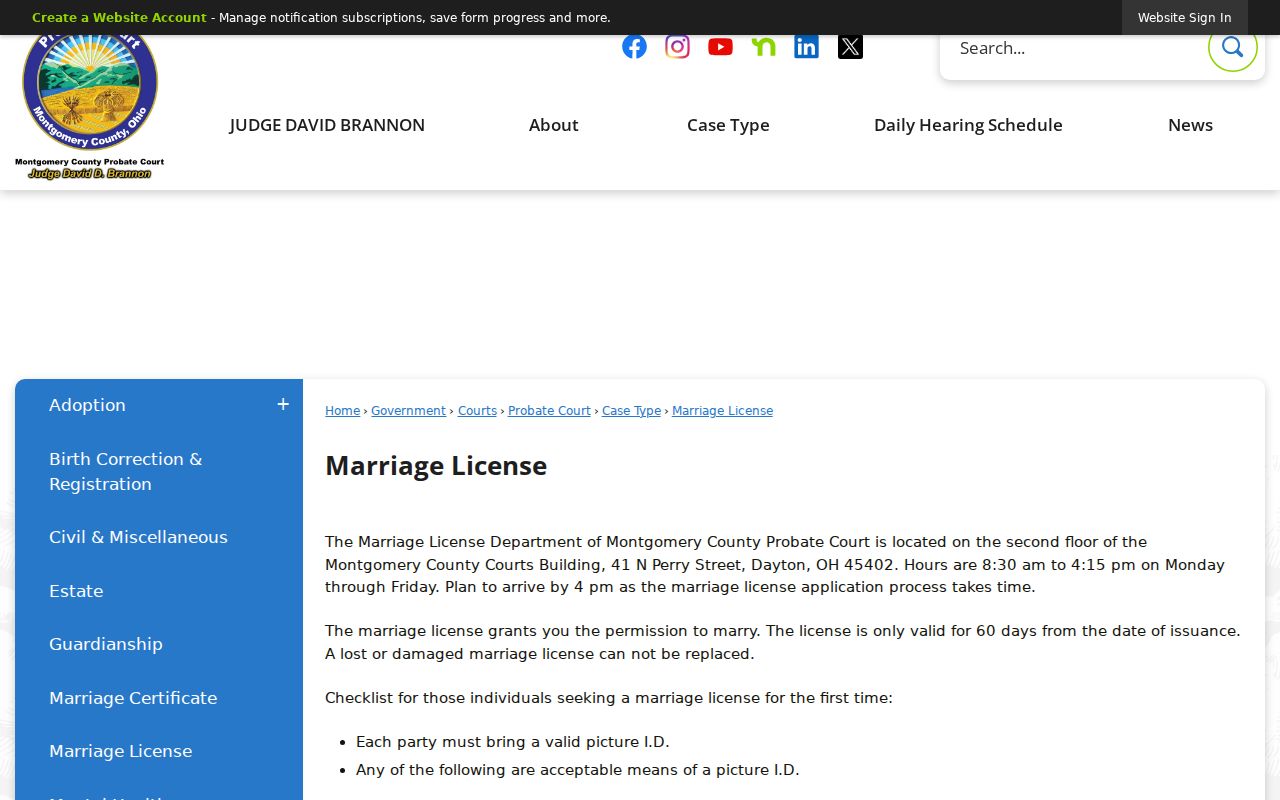
The county page confirms that marriage records follow a Probate Court route, separate from the Clerk's PRO court system.
The official Probate marriage search documents online licenses obtained after January 1, 2001. Fields cover date-issued range, party role, last name, first name. Earlier records live at the courthouse. An empty online result settles nothing older.
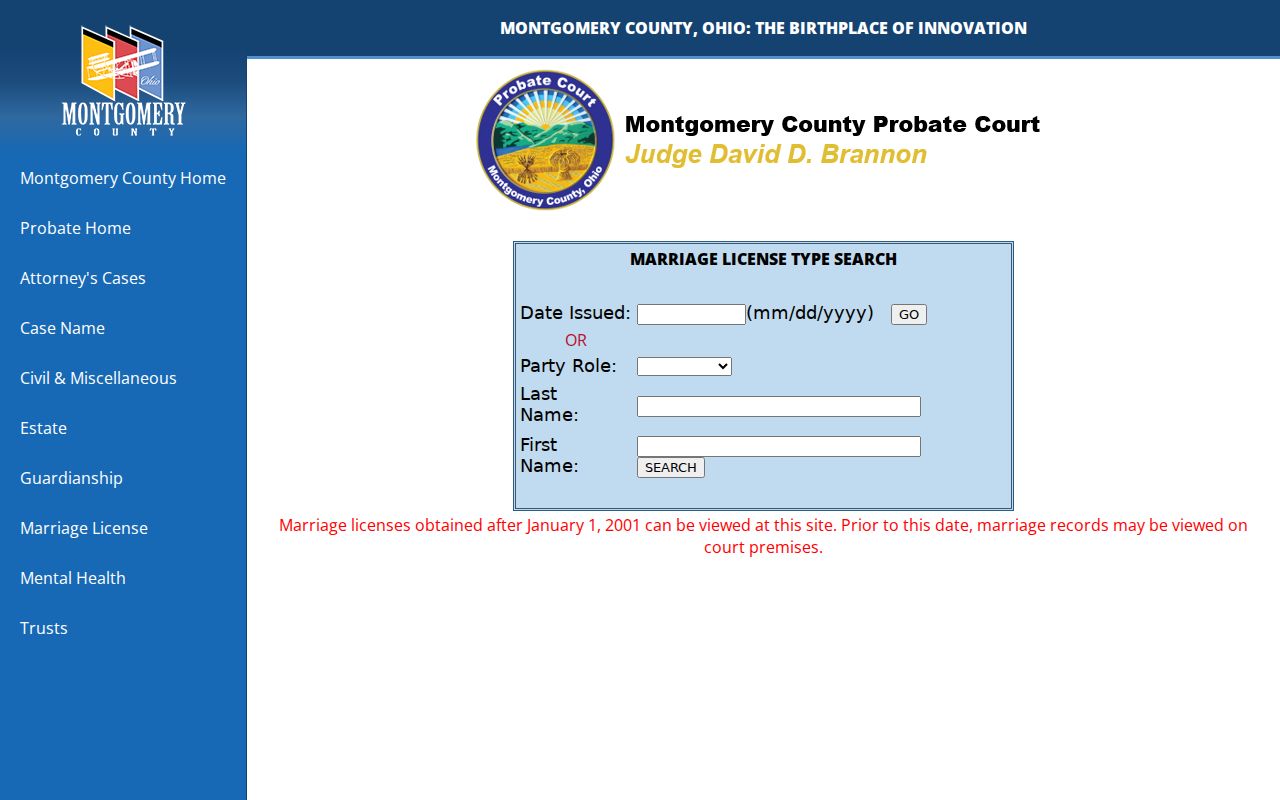
That online-and-counter boundary makes the date range and names worth preserving before requesting a court copy. Write both down first.
Verify a Trotwood Resident Record
Verification is about matching the right person to the right dated role. It is not about gathering every mention of a name. Anchor the search in one solid fact. A case number, an obituary citation, a parcel legal description, a license number, or an approximate period will all work. From there, compare middle names, initials, suffixes, and prior names across each office's entry. Weigh the dates and the role the office assigns. Keep the labels separate. An owner, a mailing addressee, a party, a licensee, and a registered voter are five different things in the Trotwood records. Treating them as one identity is how errors creep in.
- Find one candidate in the official or historical source that directly addresses the question.
- Record the name form, date, place label, case or parcel identifier, and the person's stated role.
- Check a second independent source, such as a deed against an estate case or an obituary citation against an indexed death record.
- Resolve conflicts through legal description, precinct, directory, census, or the custodian's existing record. State uncertainty when the records do not align.
- Docket
- The court's dated list of events and filings in one case.
- Index and image
- An index points to a record. An image is the filed or scanned document and may be redacted or unavailable.
- Certified copy
- A copy issued and certified by the office that keeps the official record.
Prefer to work from the property side first? The county's Trotwood streets reference keeps the parcel and deed workflow tied to the recorded property connection, so the resident lookup stays grounded in what the recorder and assessor actually show.
Trotwood Record Request Fallback
A portal is not the only route. Trotwood's public-records route sends municipal requests to the Clerk of Council for centrally maintained records. Department custodians handle specialized files. Montgomery County runs its own record-type routing. Older historical series go through the County Records Center & Archives. Ohio's Public Records Act, R.C. 149.43, governs records held by public offices, subject to listed exceptions. A request has the best chance of landing on an existing record when it names the office. Include the record type, the person or address, and a date range. Custodians do not have to build a new name dossier. They can decline exempt, confidential, or unheld material.
For historic marriage, divorce, birth, death, will, estate, deed, tax, or court material, the County Historical Public Records Request Form is a practical fallback. It asks for a request type and a description. It also asks for a first and last name, a daytime phone, and an email. Use it once the desired series and time period are clear.
Trotwood Record Role Checks
Ohio business, UCC, and professional-license sources can confirm a dated filing or credential role. They cannot prove residence. The Secretary of State business search surfaces filing context and statutory-agent information. The UCC system is a financing-statement index. eLicense Ohio reports credential information from participating boards and updates daily, yet the responsible board stays the authority on any status question. This distinction prevents a common error in a name search. An organization address, a statutory-agent address, a business location, or a credential city is not automatically a home address. Turn to these channels only when an affiliation is the fact being checked. Then label the result by the exact role shown.
Note: A role-based state record can support a dated affiliation check, but it should not be expanded into a personal location claim.
Trotwood Record Privacy Limits
Some of the most useful name-search results are limits. Ohio Safe at Home gives qualifying participants a substitute address. It works for government records, voter registration, and mail. Participant identity, address, precinct, and confidential voter-registration information stay protected from normal public disclosure. Sealed or expunged court files, protection-order material, adoption and mental-health files, medical information, and confidential investigatory records each carry their own access rules. Ohio law also restricts motor-vehicle personal information. It limits protected voter fields and municipal utility customer names, addresses, and usage information.
When an online public record includes defined personal information, R.C. 149.45 offers a written request path. It goes to the original office for redaction or an explanation of impracticability. That process cannot change an official record. It cannot bypass a protected address either.