
Find Trotwood Residents by Record
A Trotwood residents directory search works best when the question stays narrow. For an address, begin with the Montgomery County Auditor record and preserve the parcel number, legal description, sale reference, and date. For a known name, use the Montgomery voter-status form for a status check, or the Clerk's court system for a public case trail. Past household work starts at Dayton Metro Library, not with a current tax roll. A record can show an owner, a party, an addressee, or an indexed name. Those labels are not interchangeable.
Start with one dated result, then test it against an independent record. Property ownership does not name every occupant. A voter-status result is person-specific rather than a street roster. A library citation proves that a notice was indexed, not that its full text has been read. That careful approach gives the Trotwood residents directory a useful purpose without creating claims that the underlying records do not support.
- Choose a parcel, name, date range, or street as the starting fact.
- Use the county property, voter, court, or archive source that holds that type of fact.
- Record the date, record role, spelling, and any parcel or case reference.
- Compare it with a second official or historical source before drawing a conclusion.
- Ask the named custodian for an existing record when a web index stops short.
Trotwood Residents Records Desks
Trotwood sits in Montgomery County, so most property, deed, court, probate, and election counters are in Dayton. The City Clerk of Council is the custodian for centrally maintained city files, while Police, Fire and Rescue, and other departments keep their own specialized material. The county Auditor connects an address to a parcel; the Recorder keeps the documentary transfer trail; and the Board of Elections handles voter service. For a parcel-by-parcel method, use the Trotwood street directory route.
Montgomery County Recorder
451 W. Third Street, 5th Floor
Dayton, OH 45422-1387
937-225-4275
Montgomery County Auditor
451 W. Third Street
Dayton, OH 45422
937-225-4326
Montgomery County Board of Elections
451 W. Third Street
Dayton, OH 45422
937-225-5656
Trotwood Parcel Clues in MCRealEstate
The Auditor’s official MCRealEstate walkthrough gives a precise address method. Put the number in the number field and only the core street name in the street-name field. Leave out the suffix and cardinal direction. The Auditor also suggests trying variants such as “3rd” and “Third.” Open the matching result rather than relying on a typed address alone. Its summary puts ownership information and the mailing address at the top, shows current and delinquent tax items, and may link a most-recent-sale deed reference.
The mailing field deserves care. It is where tax correspondence goes and may be different from the parcel’s situs, or physical street address. It does not establish that an owner lives on site. When a deed reference is present, it can lead into the Recorder’s documentary chain, but a grantor or grantee is likewise a record role, not a full household list.
- Parcel
- A county-defined piece of land identified by a parcel number and legal description.
- Situs address
- The property’s physical street location, which can differ from the owner’s correspondence address.
- Mailing address
- The address used for tax correspondence; it is not evidence of who occupies the parcel.
- Index
- A finding tool that points to a record or document. It is not automatically the complete record image.
Note: Save the parcel identifier and legal description with the address because older deeds and plats often omit the modern street address.
The screenshot below shows the county property-search entry point used for an address-first Trotwood residents directory trail.
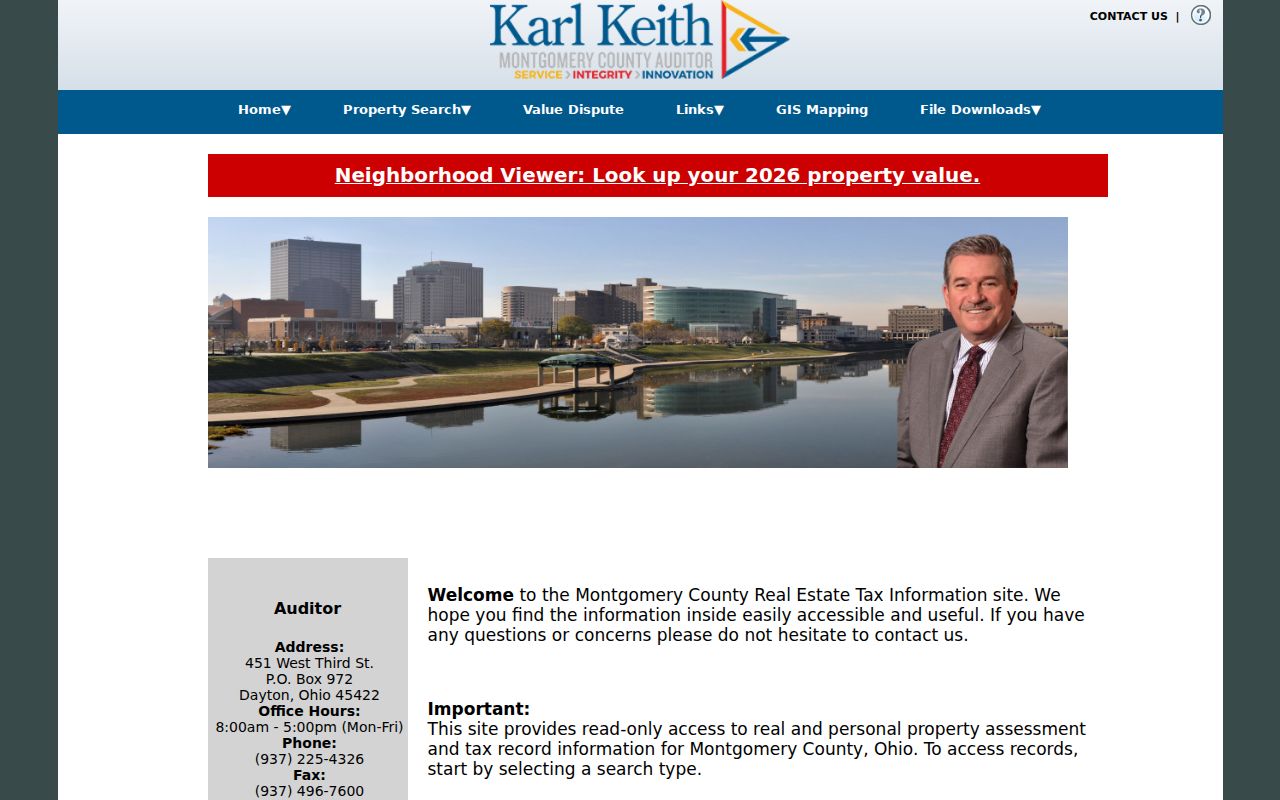
The property result is a starting record, then the sale reference and legal description help test a later deed search.
Trotwood Tax Search Field Choices
The Treasurer’s Real Estate Tax Information System supplies a second county path when an address needs a tax-year check. Select one tax year and complete only one search route for best results. Parcel numbers begin with a capital letter, owner names use last name first, and address searches use a street number with the core street name. It is a tax system, so the result supports a parcel and tax context rather than a conclusion about occupancy.
| Field | How Montgomery County describes it |
|---|---|
| Select Tax Year | Choose one year before searching. |
| Parcel ID | Enter the county format shown on a tax bill, such as A01 00107 0001. |
| Owner Name | Use Last Name First Name. |
| Street Number and Street Name | Pair the number with the core name, without direction or suffix. |
| Search | Open the Parcel ID link returned in the lower half of the page. |
That field design explains why a broad road name is a poor query. Search an exact address, compare the returned legal description and parcel ID, and then use the Recorder counter or RISS when the question shifts to a transfer document.
The Treasurer tax-search form provides the county’s parcel, owner, and address paths. A selected tax year keeps the date of a property fact clear when records are compared.
Trotwood Voter Status Is Not a Roll
Montgomery County’s voter form requires a last name and first name. It is useful for a person seeking a voter-status or precinct check, not for browsing households. The Board’s tools page also lists Street Report Generation, but the captured public page does not show its live fields or output. A careful request names an existing report, street, or precinct and asks the Board what it can release under current law instead of asking staff to assemble a new list.
Ohio protects key voter data. Safe at Home participants have confidential registration information, and Ohio law excludes protected voter information, phone and email details, identification numbers, and protected addresses from ordinary release. Voting history describes participation, not ballot choices. A no-match or limited response should be respected as an access limit, not treated as a prompt to seek a workaround.
Use Trotwood records for lawful personal research only. Do not use any address, voter, or court lead to stalk, harass, or harm a person.
Current Trotwood Residents Sources
There is no master register of people in Trotwood. Instead, each current source records a limited role. MCRealEstate and the Treasurer document parcels, owners, tax fields, and a mailing address. The Recorder indexes parties to recorded documents. Voter tools provide a name-based public status route. A city staff listing is a work-contact directory, not a private-address source. Keep the source label with each fact so an ownership record is never recast as a resident list.
| Source | Who It Lists | Keeper | Access |
|---|---|---|---|
| MCRealEstate parcel summary | Recorded owner, mailing field, sale/deed reference when linked | County Auditor | Public property search |
| Treasurer tax record | Selected tax-year parcel, owner, and address linkage | County Treasurer | Public one-field search |
| Recorder document trail | Grantor, grantee, date, and legal-description transfer | County Recorder | RISS gateway or counter |
| Voter Information Search | Person-specific voter-status and precinct context | Board of Elections | Required first and last name |
| City staff directory | Public officials, employees, roles, and office contacts | City of Trotwood | Work-contact directory |
For a name tied to a particular record rather than a street, the Trotwood resident lookup method separates a party, owner, voter, and historical subject before asking for a second confirmation.
Trotwood Court Names in PRO
Montgomery County Clerk of Courts Public Records Online, called PRO, is the county court-index channel for municipal traffic, criminal, and civil matters; Common Pleas general division cases; domestic-relations cases; and Second District appeals. Its public landing information warns that the first 1,000 matching records are returned. Online docket entries mirror the official docket but are not certified. Associated redacted document images normally appear within 48 to 72 hours after filing, though confidential material and technical problems can prevent online access.
PRO omits civil stalking, sexually oriented offense, and domestic-violence protection-order information from the internet. Sealed, juvenile, adoption, mental-health, and other confidential material may also be unavailable. For an identified case, the sound fallback is the Clerk’s Records Section, with a party name, division, approximate date, and case number if known. Certified copies require an in-person Clerk request.
The Montgomery County PRO court-record portal is pictured below.
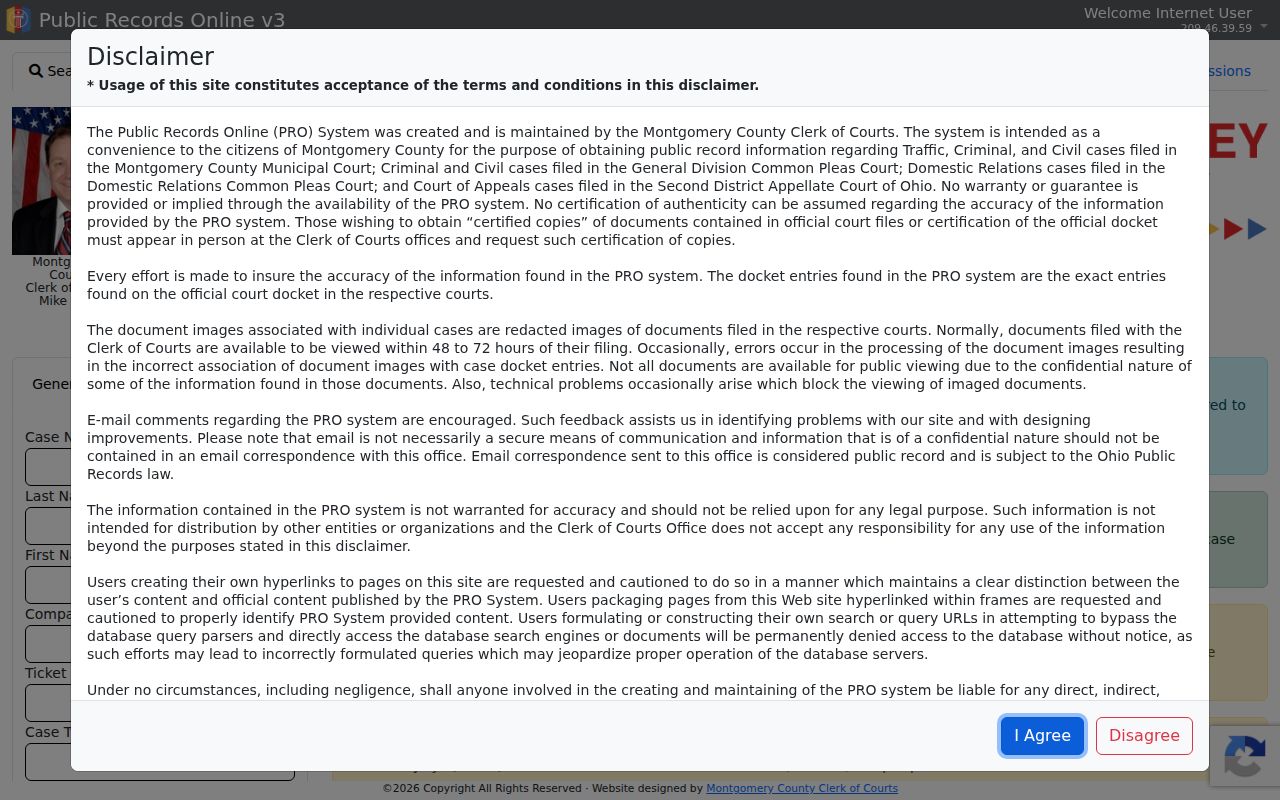
A court result is a dated party and docket lead, not proof of where someone currently lives.
Trotwood Names Before City Status
Historical Trotwood research has a geography problem worth solving early. Higgins Station developed around the 1852-53 railroads, the post office used the Trotwood name from 1866, the village plat dates to 1898, incorporation followed in 1901, and the City/Madison Township merger came in 1996. A person or parcel that belongs in modern Trotwood may therefore be indexed under Higgins Station or Madison Township. Those terms should be tried beside Trotwood in a library catalog, newspaper index, archive request, or census search.
This is more than a naming detail. The county’s historic property guidance relies on legal geography, including tract and plat information, because a modern street address may not appear in an old deed. The Recorder identifies deed custody from 1805 forward, while the County Records Center & Archives maintains historic series and a staff-searchable index for storage locations. A missing web result can be an indexing or access boundary rather than a missing record.
Trotwood Obituary and Census Trails
For a past household, the Dayton Room at Dayton Metro Library is the main local-history stop. Its holdings span more than 200 years of Dayton, Montgomery County, and Miami Valley materials. The county guide specifically sends researchers there for city directories, maps, atlases, county histories, and wills from 1805 to 1910. HOBITS, the library’s Dayton Obituary and Genealogy Database, is a citation index rather than full obituary text. It covers distinct newspaper runs from 1850 forward, with gaps, and the library will take up to three copy requests when given a complete citation.
Federal census schedules through 1950 give another dated household snapshot, but boundaries and names should be checked. A directory or obituary can lead to a census search, an estate file, or a property record. It should not be forced into a claim of continuous address history. The fuller collection path appears in the Trotwood city directory material.
The Dayton Room’s local-history page is shown here.
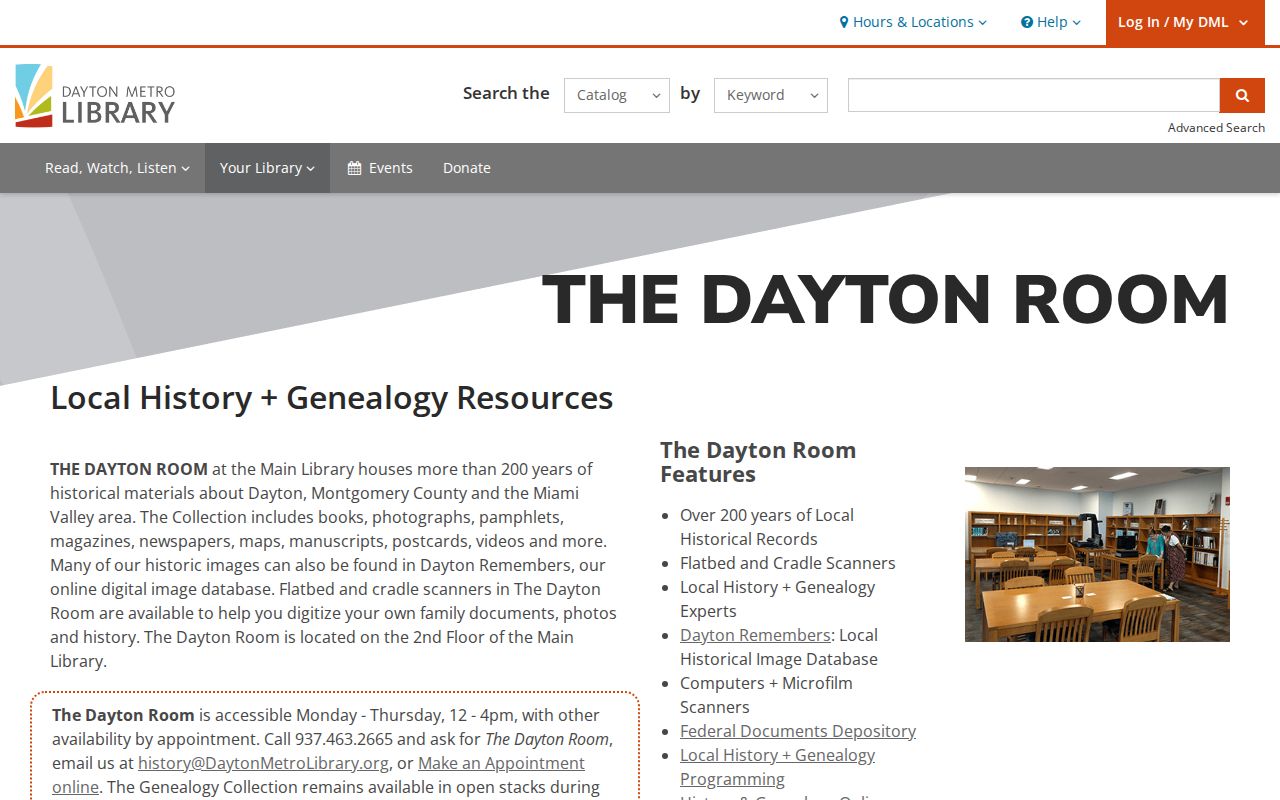
Library staff and collection tools can help identify the right title, issue, map, or obituary citation before a historical request is made.
Trotwood Records That Stay Private
Public access has real boundaries. Ohio’s Safe at Home program protects participating survivors through a substitute address and confidential voter records. Utility customer names, addresses, and usage are excluded from public-record disclosure. Online public records must protect Social Security information, and court files may be sealed, redacted, or confidential. A property owner, recorded party, or business agent may have a document connection without being a present resident.
Ohio’s Public Records Act, R.C. 149.43, is the basic fallback for an existing nonexempt record held by a public office. Trotwood accepts city requests in person, by email, or by phone; its optional RC100 form helps describe a record and choose inspection or pickup. Direct Fire, Human Resources, and Police requests to those departments. A focused request for an identified address, date range, record type, and department is more useful than a broad request for all information about a person.
The City of Trotwood public-records page identifies the local routing channels.
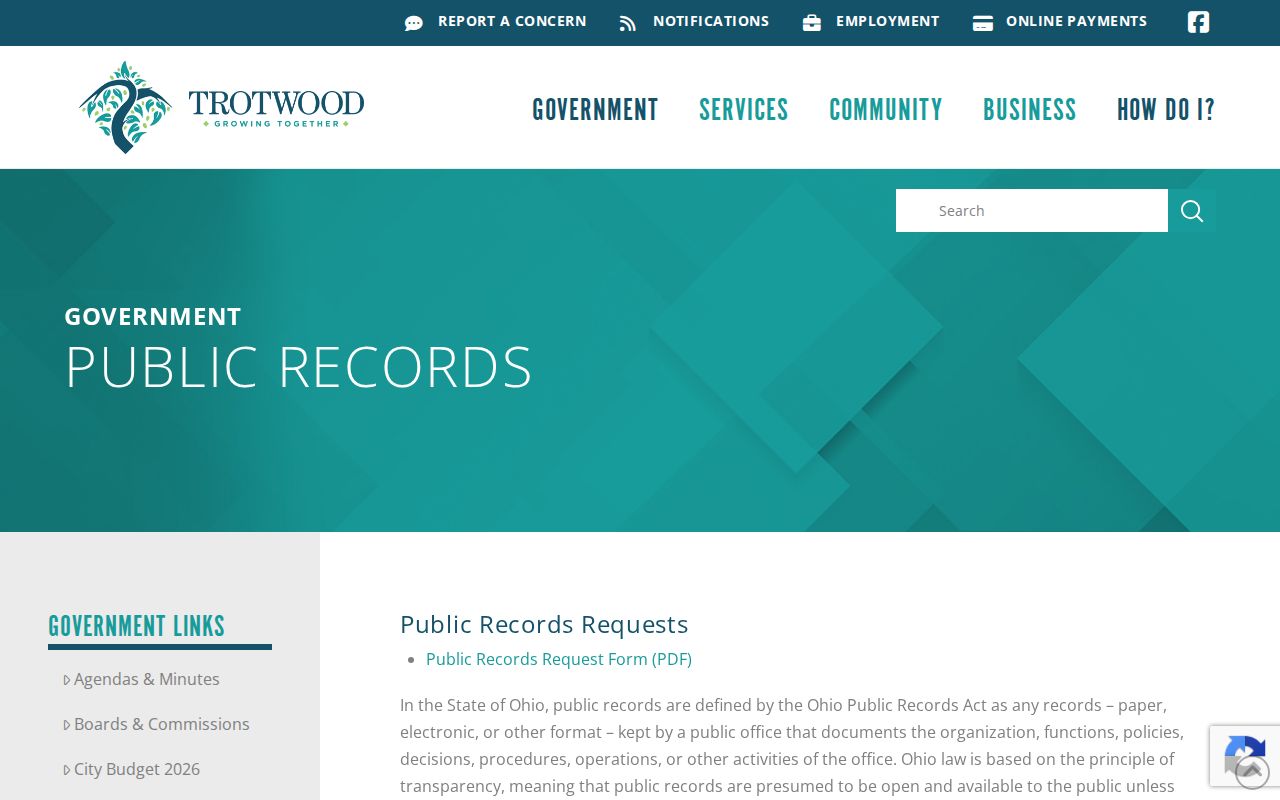
Use the custodian’s process for records that are not available in an online index.
The Ohio Public Records Act text is the statewide rule behind that access route.
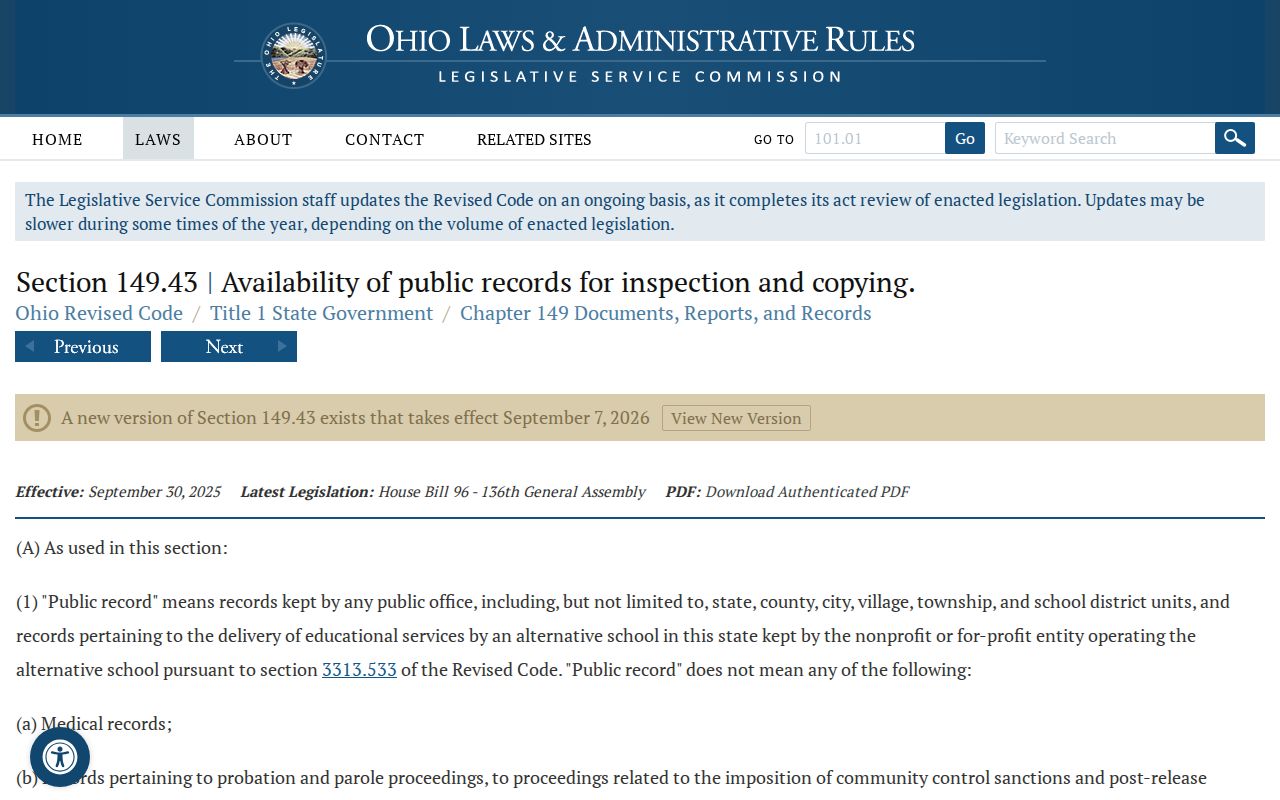
The statute establishes access to existing public-office records while preserving its listed exceptions and confidentiality rules.
Historic Trotwood Residents Directories
Historical directories are a shelf-and-catalog question in Trotwood, not a single searchable city file. Dayton Room research should consider Dayton, Montgomery County, Madison Township, and Trotwood terms. The library catalog confirms Polk city-directory material, while the county guide identifies the library as a directory source. The verified public research did not produce a complete Trotwood directory run or a readable local sample entry, so no date-by-date run is claimed here. Ask staff for the title, publisher, year, call number, and any reverse or criss-cross aid before relying on a volume.
A Haines Criss-Cross Map in the Dayton Room map collection, dated only to the 1950s, is an address orientation aid. It is not an occupant directory by itself. Pair any dated directory entry with its abbreviation key, the closest census, an obituary citation, and property or probate evidence as needed. A changed address or widow notation is a lead for more research, not conclusive identity proof.
Trotwood Record Roles Need Crosschecks
Roles are the safest way to read a Trotwood residents directory. An Auditor summary can identify a recorded owner and a mailing field. A Recorder result can identify parties to a document. A court docket can identify a party or alias. A professional license can identify a credentialed person and board record. Each helps answer a limited question. None should be converted into an assumption about a current household, a personal relationship, or a person’s location.
| Official records route | Commercial directory category |
|---|---|
| Names the public custodian, record date, and stated role. | Can combine data from many sources and may be stale or mismatched. |
| Lets a researcher ask the original office about a known document, parcel, or docket. | May offer its own correction or opt-out process, but cannot correct the source record. |
| Requires the reader to respect statutory exceptions and record-specific limits. | Still requires independent checking and lawful personal use. |
Ohio’s eLicense system is a useful example. It searches professional, business, occupational-license, and certification data from 24 participating boards and updates daily. A typical result can show a name, status, board, credential type and number, dates, city/state/country, and board-action indicator. Search with a last name plus first initial and the board when possible. It provides a credential lead, then the issuing board remains the authority.
The eLicense Ohio lookup shows the public state-board route.
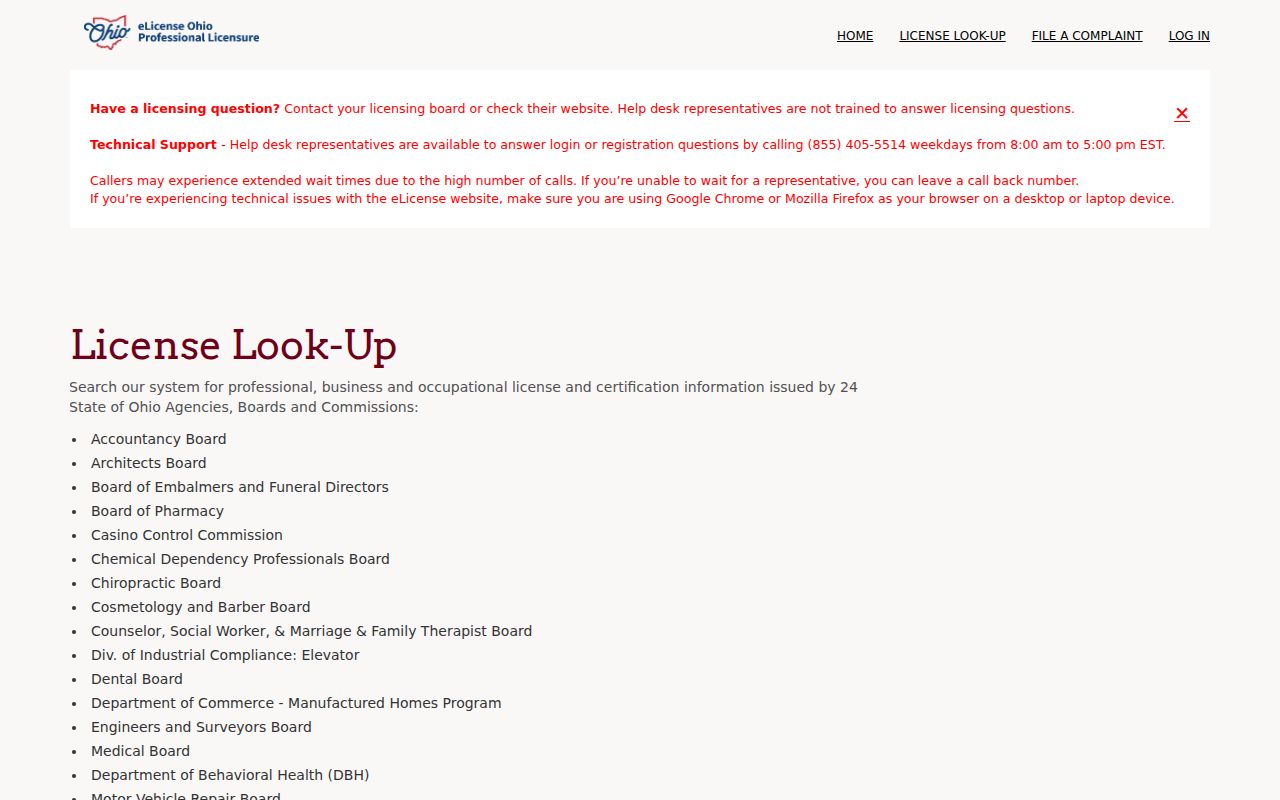
Use a credential result to verify the official professional record, not to construct a resident profile.
Trotwood Custody Screens Have Limits
Some official name screens cover narrow custody or regulatory scopes. The Montgomery County jail page lists only people currently in the jail and updates every 30 minutes. Ohio’s Department of Rehabilitation and Correction search covers people currently incarcerated in an Ohio prison, under department supervision, or judicially released. It does not replace a court docket, a county jail record, or an address verification. A listed address can also lag a move.
These screens are most useful when the record question fits their stated scope. A current jail record is not a warrant history. A prison/supervision record is not proof of a person’s current Trotwood presence. Record the source date and status, then consult the named agency or court for authoritative follow-up. Official portals keep the relevant scope visible, which is one reason they are preferable to unsourced directory claims.
The Ohio offender-search interface illustrates its status and name filters.
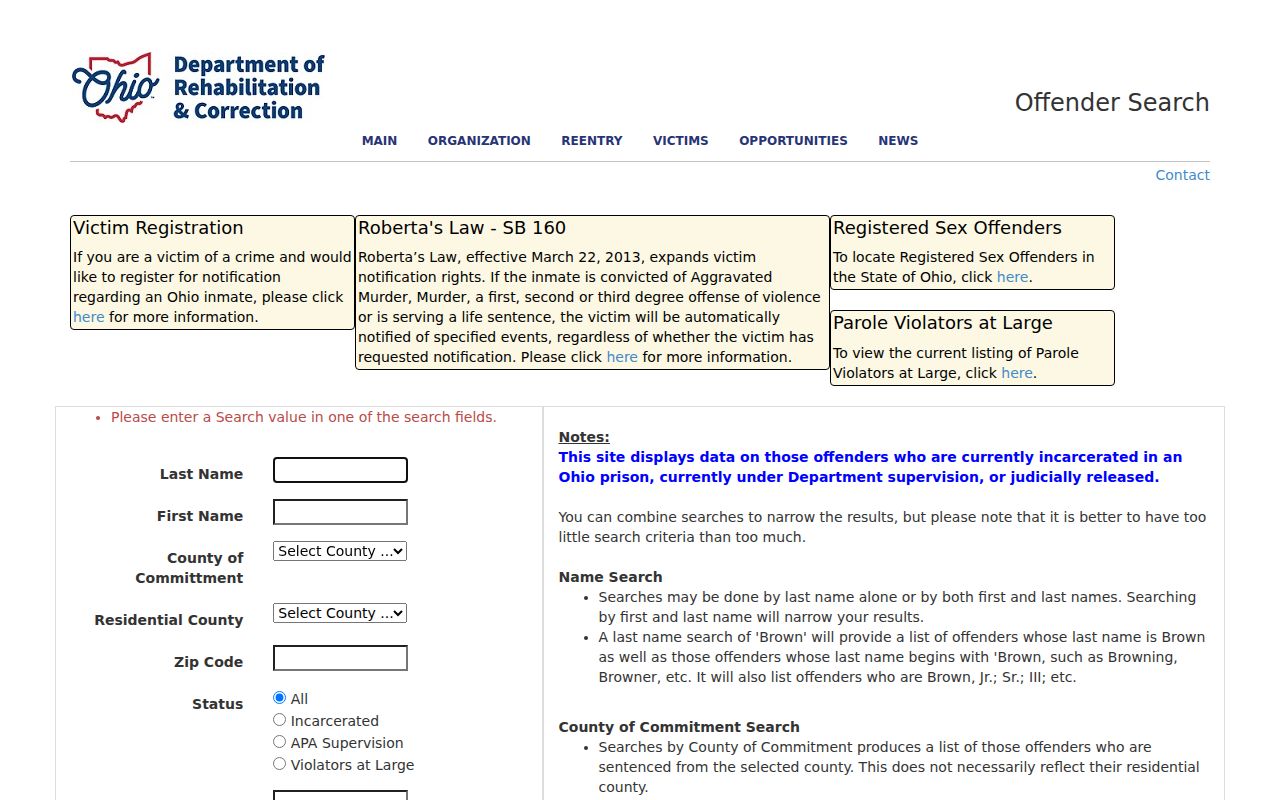
The selected status and county filters limit a result set, but they do not establish a current residential address.
Trotwood Recorder Alerts and Requests
One timely property-record tool is the Montgomery County Recorder’s free Fraud Alert Network. It sends an alert for documents recorded under an enrollee’s name and supplies an instrument number for review. An alert is not automatically fraud. A mortgage satisfaction can trigger one, so the sensible next step is to use the number in RISS or call the Recorder. The Recorder’s April 2025 newsletter also reported that quitclaim deeds submitted for transfer receive a fraud pre-check.
For older or unavailable documents, use the Recorder counter and the County Records Center & Archives rather than assuming the online gateway contains every record or image. The historical request form supports an identified series such as deed, tax, marriage, divorce, will, estate, or court material. Give a clear description, name, date range, and any known book, page, parcel, or case reference. That is the practical way a Trotwood residents directory search continues when a link stops.